Evaluating the Lace Border Clipart Collection for Design Projects
In the realm of digital design, the choice of decorative elements often dictates the tone and professionalism of a final product. The Lace Border Clipart Collection represents a specific category of assets designed to bring vintage elegance and intricate detail to stationery, branding, and packaging. Unlike generic clip art found in basic software libraries, this collection focuses on high-fidelity line art vectors that mimic traditional lace trims, doilies, heart motifs, fan patterns, and corner ornaments. For designers aged 20 to 50 who are balancing aesthetic goals with technical requirements, understanding the nuances of this resource is essential before integrating it into a workflow.
This article examines the practical applications, technical specifications, and comparative advantages of the Lace Border Clipart Collection. It aims to provide a balanced view of when these assets serve as an optimal solution and when alternative approaches might be more appropriate for your specific project needs.
Defining the Core Assets and Technical Specifications
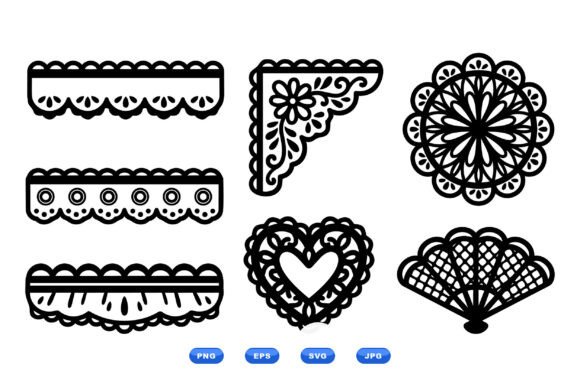
The Lace Border Clipart Collection is not merely a set of images; it is a structured library of scalable vector graphics. The defining characteristic of this set is its composition of 100 distinct vector artworks. These elements range from continuous border trims suitable for page edges to isolated corner ornaments and standalone doily shapes. The inclusion of heart and fan motifs adds versatility, allowing for thematic variations within wedding invitations, luxury packaging, or romantic branding campaigns.
From a technical standpoint, the collection is delivered as a downloadable ZIP file containing multiple formats: SVG, PNG, JPG, and EPS. This multi-format delivery is a critical factor for professionals. The SVG (Scalable Vector Graphics) and EPS (Encapsulated PostScript) files ensure that the artwork remains crisp at any size, from a small social media icon to a large-scale banner print. The PNG and JPG files offer rasterized versions with transparent backgrounds, which are useful for quick web implementations where vector editing is unnecessary.
The "line art" style of the collection is particularly significant. Unlike solid-color illustrations, line art relies on stroke weight and path precision. This makes the designs highly adaptable to color changes without losing structural integrity. A designer can easily recolor a black lace border to gold foil or soft pastel pink to match a brand palette, a flexibility that is often limited in pre-colored bitmap assets.
Comparing Vector Collections Against Raster Alternatives
When evaluating resources for decorative borders, the primary comparison lies between vector-based collections like this one and raster-based alternatives. Raster images, such as standard JPEGs or low-resolution PNGs, are pixel-dependent. When scaled up, they suffer from aliasing and blurriness, which can ruin the delicate details of lace patterns. In contrast, the Lace Border Clipart Collection utilizes mathematical paths, ensuring that every curve and intersection remains sharp regardless of output size.
Another common alternative is creating custom lace patterns from scratch using tools like Adobe Illustrator or Inkscape. While this offers total creative control, it is time-intensive. Crafting a single complex doily pattern can take hours of manual node manipulation. For projects with tight deadlines, the efficiency of a pre-made collection becomes a decisive advantage. The trade-off here is customization versus speed. With the Lace Border Clipart Collection, you gain immediate access to professional-grade geometry, but you are limited to the existing designs unless you have the skills to modify the vector paths significantly.
Furthermore, many free online clip art repositories offer similar themes but often lack the cohesive quality of a dedicated collection. Free assets frequently come with inconsistent line weights, closed paths that cannot be edited, or licensing restrictions that prevent commercial use. The Lace Border Clipart Collection addresses these issues by providing a unified set of 100 pieces with consistent styling and clear usage rights for both print and digital applications.
Format Flexibility and Workflow Integration
The availability of SVG, PNG, JPG, and EPS files positions this collection as a versatile tool across different stages of the design process. The EPS format is particularly valuable for professional print workflows, ensuring compatibility with offset printing presses and large-format signage. SVG files are ideal for web developers, as they can be embedded directly into HTML or styled with CSS, reducing page load times compared to heavy image files.
For users working in non-vector environments, such as Microsoft Word or simple photo editors, the PNG files with transparent backgrounds offer a practical solution. However, it is important to note that once a vector is flattened into a PNG, it loses its scalability. Therefore, the decision to use PNGs should be reserved for final outputs where resizing is no longer anticipated.
Use Cases and Best-Fit Scenarios
The Lace Border Clipart Collection is best suited for projects requiring a touch of sophistication and tradition. Its primary strength lies in industries where elegance is a key selling point. Wedding planners, for instance, frequently utilize these assets for invitations, menus, and place cards. The heart and fan motifs specifically cater to romantic themes, while the corner ornaments provide a frame that draws the eye inward without overwhelming the text.
In the realm of branding, the collection serves well for boutique businesses, artisanal food packaging, and beauty products. A soap company, for example, might use a lace border on a label to suggest natural, handcrafted qualities. Similarly, a high-end stationery brand could incorporate these elements into letterheads or envelopes to establish a premium identity. The ability to scale the artwork ensures that the same asset can be used consistently across business cards, website headers, and shipping boxes.
Crafters and DIY enthusiasts also benefit from these files. Because the designs are vector-based, they can be imported into cutting machine software like Cricut Design Space or Silhouette Studio. This allows users to cut the lace patterns out of paper, vinyl, or fabric with precision, enabling the creation of physical scrapbooks, greeting cards, and home decor items.
Limitations and Decision Factors
While the Lace Border Clipart Collection offers significant advantages, it is not a universal solution for every design challenge. One limitation is the stylistic constraint. The collection is inherently tied to a vintage, Victorian, or shabby-chic aesthetic. If a project requires a modern, minimalist, or brutalist look, these intricate lace elements may feel out of place or visually cluttered. Designers must evaluate whether the ornate nature of the lines aligns with their overall visual strategy.
Additionally, the reliance on line art means that the designs rely heavily on contrast. On busy or textured backgrounds, thin lace lines may become indistinguishable. In such cases, thicker geometric borders or solid shapes might communicate the message more effectively. Users should consider the background complexity of their project before committing to fine-line lace patterns.
Another factor to consider is the learning curve associated with vector editing. While the files are provided in editable formats, modifying them requires proficiency with vector software. A user unfamiliar with anchor points and Bezier curves may find it difficult to customize the designs beyond simple color changes. For those lacking these technical skills, the collection functions best as a "use-as-is" resource rather than a base for extensive modification.
Strategic Selection: When to Choose This Resource
Choosing the Lace Border Clipart Collection should be a deliberate decision based on specific project requirements. It is the right choice when:
- Scalability is critical: You need assets that will appear in various sizes, from mobile screens to billboards, without quality loss.
- Aesthetic consistency matters: You require a unified set of 100 elements that share the same line weight and stylistic language.
- Time efficiency is a priority: You need professional-quality decorative elements immediately without the overhead of drawing them from scratch.
- Multi-platform use is required: Your project spans both print (EPS/SVG) and digital (PNG/JPG) mediums.
Conversely, you may need to explore other options if:
- Your design brief demands a strictly modern or industrial aesthetic that clashes with traditional lace motifs.
- You require fully customizable, unique patterns that cannot be achieved by tweaking existing vector paths.
- Your workflow does not support vector file formats, and you only have access to basic raster editing tools with limited resolution capabilities.
Conclusion on Value and Application
The Lace Border Clipart Collection stands out as a robust resource for designers seeking to infuse elegance into their work through high-quality vector art. By offering a comprehensive suite of formats and a wide variety of motifs, it bridges the gap between traditional craftsmanship and digital efficiency. However, its value is maximized only when applied to projects that align with its vintage, ornamental character. By weighing the benefits of scalability and format diversity against the stylistic limitations and technical requirements, designers can make informed decisions about whether this collection fits their specific creative needs. Ultimately, the choice depends on balancing the desire for intricate detail with the practical constraints of the project timeline and target audience expectations.